
Early Childhood Education
A strong place to begin
The first years lay the foundations for everything that follows — language, early literacy and numeracy, confidence, curiosity, relationships and the ability to learn.
In Uganda, public primary education is widely available. Public provision of pre-primary is more limited and predominantly private. For children in underserved rural communities, this creates an early gap. Some start Primary One having had little structured early learning, not because families do not value it, but because affordable, quality provision has not yet been available close by.
Tusome Africa exists to strengthen that early part of the journey, within existing schools and communities.
Explore our approach ↓Why early learning matters
A strong start should not depend on where a child is born
The first years of life are a critical period for learning and development. They shape how children communicate, explore the world, build relationships and approach the learning that follows.
In Uganda, public primary education is widely available, but public provision of pre-primary education is more limited and predominantly private. For families in underserved rural communities, access to affordable, quality early learning close to home can be difficult.
Some children begin Primary One having had little opportunity to experience books, numbers, structured play or group learning. This is not because their families do not value education, but because suitable provision has not always been available to them.
Tusome Africa works to strengthen this early part of the journey within existing schools and communities.
Our approach
Community-based, school-connected
We do not build from scratch where existing assets can be strengthened. We identify underused classrooms and community structures that can be safely rehabilitated and adapted for young children.
This keeps costs low, uses what is already there, and connects early learning directly to the primary school a child will join.
Strengthen what exists
We adapt suitable school and community spaces to create safe, welcoming environments for young children, making better use of existing local assets.
Invest in local women
We recruit women from the communities they serve and invest in their skills, teaching practice, professional growth and recognition.
Connect to primary school
We strengthen the links between early learning, families and public primary schools, supporting a smoother transition into Primary One.
How the model has evolved
Learning through implementation
Our approach has evolved through experience. Each phase has helped us understand what makes early learning more accessible, practical and sustainable.
School-based provision
We began by working through government-aided primary schools, creating and refurbishing ECE spaces. We learned that low fees alone did not make access equitable.
Community-based provision
We developed a community-based approach, recruiting women locally as paraeducators. Access improved. We also learned that community spaces, while valuable, are not always permanent or suitable for long-term provision.
Bringing strengths together
Today we bring the strongest elements together: community-based recruitment and ownership, combined with increasing integration within public primary schools for permanence, continuity and a smoother transition into Primary One.
The people behind the learning
The educator is at the heart
A safe classroom matters. But a room cannot teach a child.
Women are central to this model. In rural communities, women are closely involved in the care and development of young children and hold knowledge of local families, languages and dynamics. Many have had limited opportunities for formal employment and professional recognition.
We recruit locally and invest in women as educators.
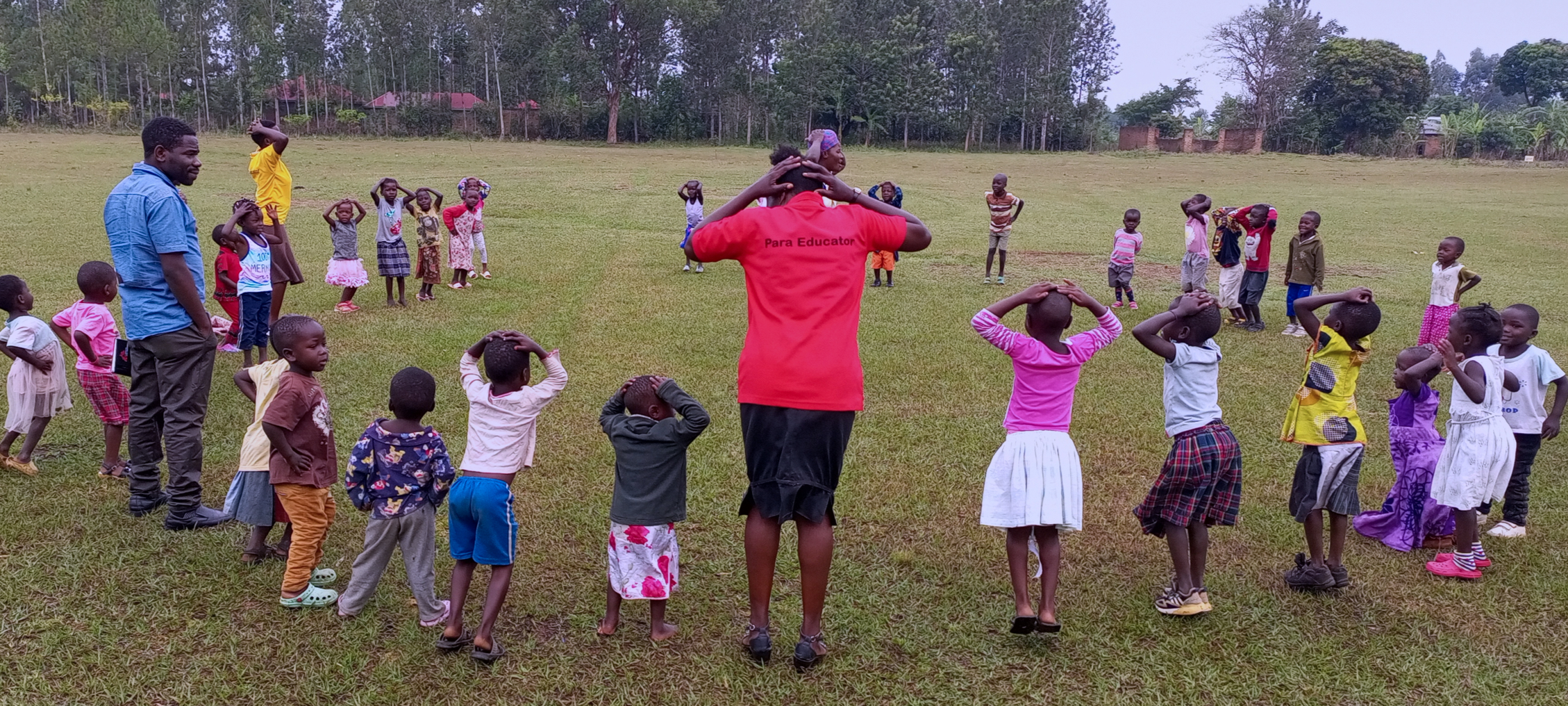
Paraeducators receive induction in child development, play-based pedagogy, early literacy and numeracy, classroom management, safeguarding and observation — followed by ongoing mentoring, classroom observation and peer learning.
Children gain a trusted, familiar educator who knows their context. Women gain skills, income, confidence and a route to formal recognition.
Learning in practice
What happens inside
Structured, play-based, child-centred learning — listening and speaking, stories and books, counting and problem-solving, drawing and music, outdoor play, and learning how to be part of a classroom.
Not formal primary pushed down early, but the experiences that build school readiness.
These experiences help children build the language, early literacy and numeracy, confidence, curiosity and relationships they need to take part in learning.
Planning for the long term
Build → Embed → Sustain
We do not want centres that depend on Tusome indefinitely. Sustainability is part of how we design the programme from the beginning.
Establish the foundations
Adapt existing space, recruit and train educators, provide materials, and establish safeguarding and monitoring.
Strengthen local capacity
Strengthen teaching, parent engagement, community governance and integration with the school.
Support local ownership
Responsibility increasingly sits with the school and community, with Tusome moving to lighter-touch technical support.
Why this work matters
What a strong start can mean
Quality early learning can make a difference beyond the classroom. It supports children as they prepare for primary school, while strengthening the people and local systems around them.
For a child
Entering Primary One having experienced books, numbers, play and group learning, confident to participate.
For an educator
Skills, employment and professional growth in her own community.
For a school
Being better prepared to receive young learners.
For a community
Greater capacity to sustain quality early learning, within its own education system.
Stories from our work
Learning, change and the journey ahead
Our approach continues to evolve through the experiences of children, educators, schools and communities. Explore some of the stories behind the work.
The story of Nakalama
How experience on the ground has shaped our approach and helped us move through the phases of building, embedding and sustaining early learning.
Read the Nakalama story →Following John's learning journey
Returning to the child whose story first brought the importance of access into focus, and reflecting on his journey, what has changed and what it tells us about the value of early learning.
Follow John's journey →Early Childhood Education · Tusome Africa
Every child deserves a strong start.
We are working towards a future where children in underserved communities can access quality early learning, educators are equipped to support them, and communities are better placed to sustain that opportunity.