
Foundational Skills for Learning
Creating places where reading can happen.
A book only becomes useful when a child can open it, understand it and enjoy it.
For some children, books are part of everyday life — at home, at school, in libraries. For many children in the schools where we work, that is not yet their experience. There may be a classroom full of children who want to read, but very few books. There may be a room that could become a place for reading, but little available to make it useful.
We want to help change what is possible when a child has access to books and a place to read.
Explore our approach ↓Start with the school
We start with what the school already has
Every school is different. Some have a suitable room but very few resources. Others have books but no dedicated space. Some have both, but need support to build the routines that turn resources into regular learning.
So we begin by understanding what is already there.
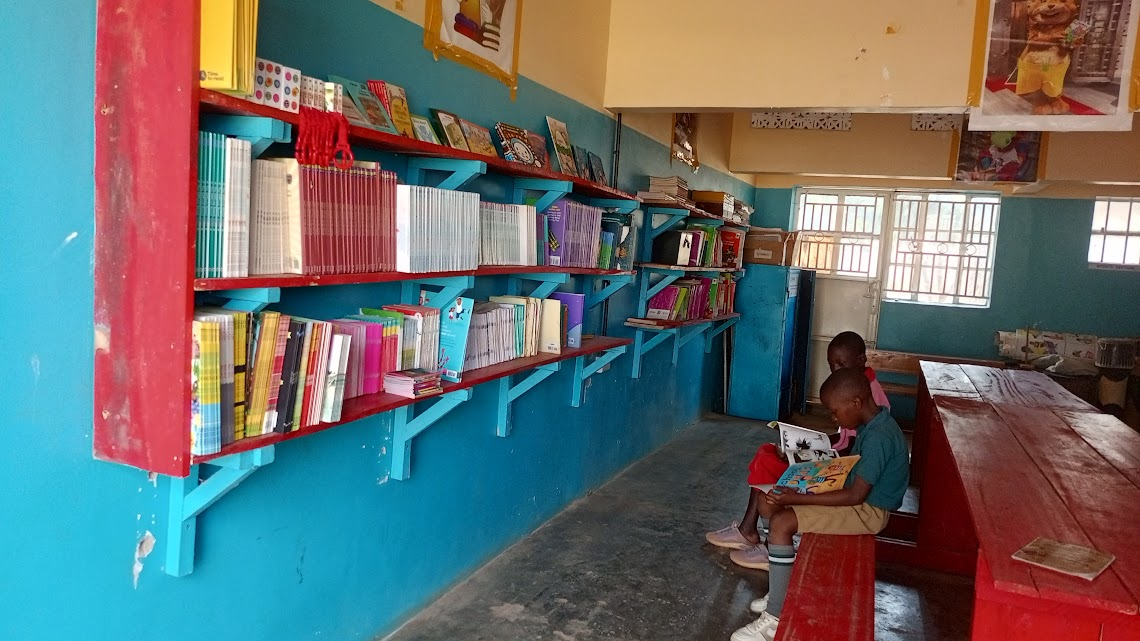
Tusome works with schools to turn available spaces into welcoming reading and learning environments. Where possible, we use what already exists — an underused classroom, a vacant room, a quiet corner — rather than building new infrastructure.
We provide or mobilise appropriate books and learning resources and work with teachers to encourage regular use.
Use a real school photograph, ideally showing the room before or during its transformation.
Make room for reading
Adapt an available classroom, vacant room or quiet corner into a welcoming environment where children can read, explore and learn.
Equip it for learning
Provide or mobilise suitable books, early readers, literacy and numeracy resources, and games that support learning.
The functional reading space
More than a room full of books
A Tusome reading space is a functional space within a school. It brings together the environment, resources, activities and people needed to make reading part of everyday learning.
But the programme is about more than putting books on shelves.
Clever space
Practical conversion of existing rooms rather than expensive new construction. We make use of what a school already has wherever possible.
Books and resources
Storybooks, early readers, literacy and numeracy materials, and games like chess and Scrabble that encourage curiosity and problem-solving.
Active programming
Reading groups, guided reading, read-alouds, storytelling, book clubs, debates, creative writing and spelling challenges.
Teacher engagement
Focal teachers connect library resources to classroom learning and help children use books and activities regularly.
Student leadership
Library champions promote reading, support peers and help care for books and learning resources.
School ownership
Responsibility progressively sits with the school, so the space, resources and reading activities become part of normal school life.
Reading in action
What happens inside
A reading space comes to life through the activities that take place there — and through the opportunities children have to use books and learning resources in different ways.
Guided reading
Reading sessions that support fluency, comprehension and confidence.
Stories and read-alouds
Listening, storytelling and discussion that build vocabulary and understanding.
Book clubs and reading groups
Opportunities to discuss books, share ideas and discover reading for pleasure.
Book borrowing
Extending reading beyond the classroom and into children's everyday lives.
Debates and creative writing
Developing expression, imagination and the confidence to communicate ideas.
Games and problem-solving
Numeracy games, chess and Scrabble that encourage concentration, vocabulary and reasoning.
Learning from practice
Paying attention to what happens next
Opening a reading space is a beginning, not the end.
We want to know: Are children using the books? Are teachers using the space? Are children getting more opportunities to read? Which resources are most used? Where are children still struggling?
This is where this work connects with our Assessment & Learning Data programme. The strongest reading programme is one that pays attention to the children in front of it.
Explore our Assessment & Learning Data work →Use a photograph showing teachers or mentors working directly with children.
Building a culture that lasts
Build → Embed → Sustain
We currently support 13 reading spaces — 10 in Iganga and 3 in Wakiso. Over eight years we have provided 20,000+ books, and introduced chess and Scrabble in 5 schools alongside reading activities and book clubs.
Our ambition is to maintain and strengthen these 13 spaces, with potential to add 2–3 per year subject to funding.
Establish the space
Prepare the room and put the foundations in place.
- Identify and prepare suitable space
- Organise books and resources
- Orient focal teachers
- Identify library champions
- Launch reading activities
Make it part of school life
Strengthen the routines that keep children and teachers engaged.
- Mentoring and activity support
- Regular reading sessions
- Book borrowing systems
- Student leadership
- Monitoring and learning
Support lasting ownership
Enable schools to manage and maintain the reading environment.
- School-led library activities
- Care of books and resources
- Ongoing reading routines
- Light-touch mentoring
- Quality assurance
The difference is in the use
When a reading space becomes part of learning
The moment that matters is not the photograph of a new bookshelf. It is the child who picks up a book without being told. The group that gathers around a story. The teacher who finds a new way to help a child with a difficult word. The pupil who begins reading to a younger child.
Because a reading space only matters when children are using it to learn.
Prioritise a natural photograph of children using the space, rather than a posed photograph of bookshelves.
See the work in practice
A tour of our reading spaces
Tusome transforms existing school spaces into functional reading and learning environments — without requiring expensive new infrastructure — helping schools build a lasting culture of reading, curiosity and discovery.
Foundational Skills for Learning · Tusome Africa
Every child deserves the chance to discover what a book can open up.
We work with schools to create reading environments that children want to use, teachers can build into learning, and communities can sustain.
Explore our reading spaces →