

In the same class, one child may read a passage with confidence while another struggles to make sense of the words. A third may be able to read aloud but find it difficult to explain what the passage means. If we only look at whether the lesson was taught, the exercise completed or the examination passed, some of these differences can go unnoticed.
For teachers, knowing where to begin can be difficult when they are responsible for many learners with different needs, large classes and competing demands. For school leaders and education authorities, the challenge is broader: understanding whether children are learning across classes and schools, where the gaps are greatest, and what kind of support might make a difference.
This is why assessment matters. But assessment alone is not enough.
We need information that helps us understand what children know, where they are struggling and what may be preventing them from progressing. More importantly, we need to use that information to decide what happens next. The purpose of learning data is not simply to describe the problem more accurately. It is to help us respond to it.
1. A child can be in class without keeping up
Across sub-Saharan Africa and the Global South, children can spend years in school without mastering foundational skills. Uganda is not alone in this.
Sources and further reading
Uwezo Uganda — National Learning Assessment Report 2024 (PDF) ↗
World Bank — The State of Learning Poverty: February 2023 Update (PDF) ↗
Uwezo Uganda's 2024 assessment found that 23% of Primary Seven pupils could not read and comprehend a story intended for Primary Two, compared with 11.3% in 2021. The World Bank's pre-pandemic estimate was that 86% of children in sub-Saharan Africa were in learning poverty, once children out of school were accounted for.
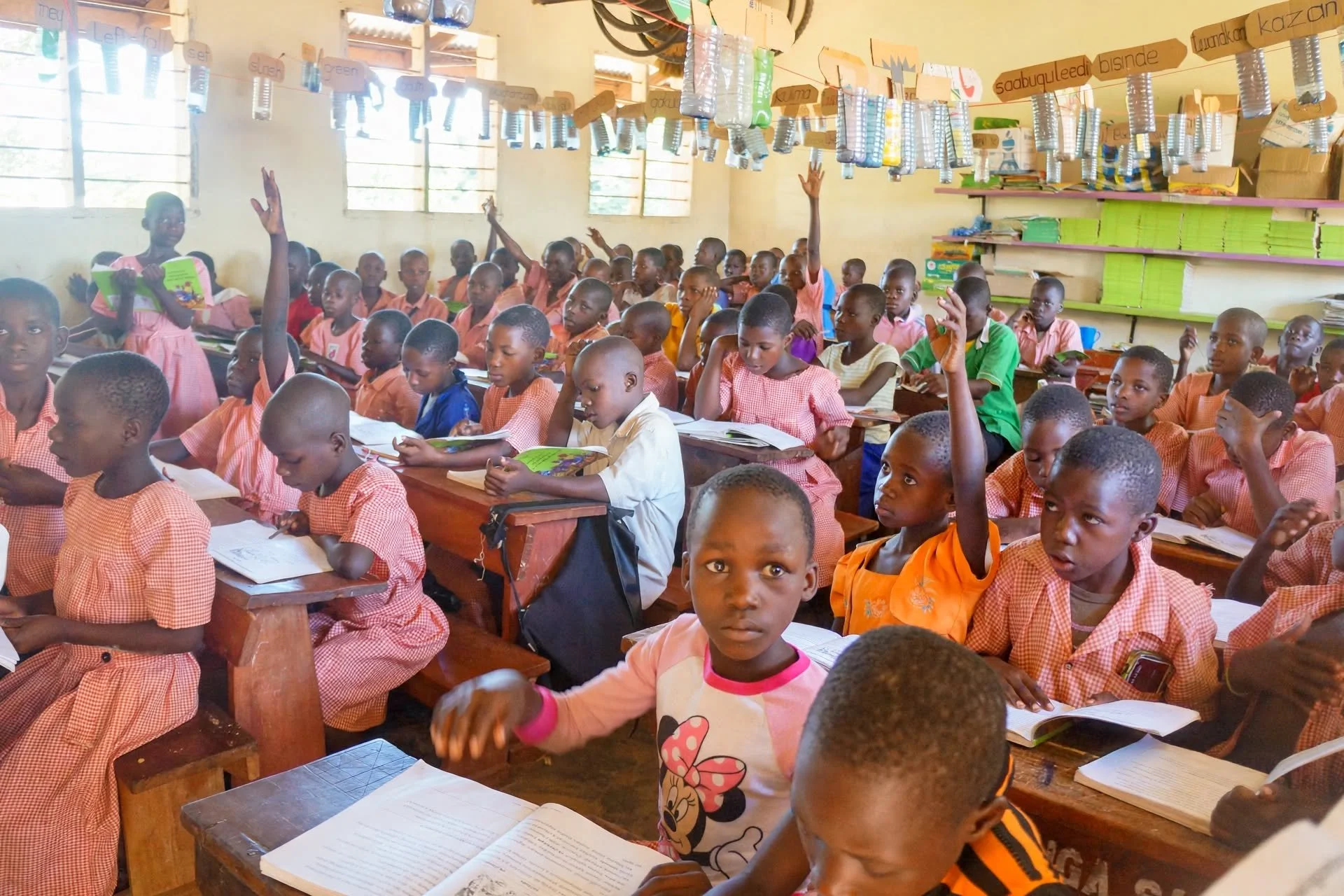
Behind each figure is a classroom where children in the same class are at very different points. One child may have had books at home and strong early learning. Another may be encountering structured learning for the first time. A teacher working with limited time and materials must hold both realities at once.
Being present in class matters. It is not, on its own, enough to tell us whether a child is learning.
2. Assessment should help us understand, not simply measure
End-of-term examinations have their place. They tell us how a child performed at a point in time.
Assessment for learning asks a different question: what does this child know now, where did the difficulty begin, and what would help them move forward?

A score may show that a pupil struggled with a reading task. It does not tell us whether the difficulty was recognising letters, reading fluency, or understanding meaning. Without that detail, it is harder for a teacher to decide what to do next while there is still time to make a difference.
Good assessment makes learning visible enough to act on.
3. Data only matters when it changes what happens next
Collecting assessment results is only the beginning. Its value lies in what people do with it.
In practice, this might mean…
For a teacher: grouping children differently for a week, revisiting a concept, or giving more time to practise.
For a headteacher: noticing that several classes are struggling with the same area and deciding to focus teacher support there.
For a district education office: seeing that patterns are concentrated in certain schools or sub-counties and targeting supervision and resources more carefully.
In each case, the data is useful because it helps someone decide what to do next — not because it sits in a report.
4. Look beyond the individual score
Understanding learning requires more than individual marks. Patterns matter.
When we look across a class, a school or a group of schools, we can ask: what are children finding difficult? Where are gaps most pronounced? What might be contributing to them — is it consistent across subjects, linked to attendance, or to a particular stage where learning begins to dip?
Individual scores tell us about a child. Patterns help us understand the conditions around that child.
That is why we need information that can be understood at different levels — classroom, school and district — without creating a separate, complicated reporting burden for teachers.
5. The measure of success is what changes for children
At Tusome Africa, we are developing this work through our partnership with the Iganga District Education Office. Iganga has 99 government-aided primary schools and around 60,000 learners. Over three years, together we have established a District Quality Team, developed curriculum-aligned assessments, seen voluntary adoption by around 80 schools, assessed more than 12,000 learners and engaged over 300 teachers — using paper-based tools, Excel and SPSS.
That experience has shown the value of a shared evidence base and the limits of managing it manually. It is the basis for Responsive Data — a government-owned approach designed to bring together information schools already generate, so it is easier to use within routine education management.
An important distinction
The digital platform is still in development; its impact is not yet proven and will be tested through phased implementation and independent evaluation.
We frame the work simply:
From information to improvement
Collect: Understand what children know and can do.
Understand: Identify learning gaps and consider what lies behind them.
Act: Use the findings to guide teaching and support.
Improve: Review what has changed and adapt the response.
This is not a technology solution. Its value is not in digitising information for its own sake, but in helping teachers, schools and education leaders make better decisions with reliable, accessible information.
The wider challenge is not unique to Uganda. But the response must be rooted in specific classrooms, schools and districts — with people who know those children and are supported to use information well.
Better information should lead to better learning
The purpose of data is not to produce more reports, figures or dashboards. It is to help children learn better.
We cannot respond to learning needs we do not understand. And understanding only matters when it leads to action.